Among the most efficient ways to transfer money online in this day and age turns out to be Blockchain. It is secure to the point of being almost airtight, and with rising popularity and soaring prices of cryptocurrency like Bitcoin, it is turning out to be pretty profitable for people who collect cryptocurrency as a means of investment.
Structurally, Blockchains are among the safest technologies we have available when it comes to exchanging money. Also, since there is little restriction on how much you can spend your money, and so sending payments across borders becomes easier. Here’s how the technology works.
You purchase a Bitcoin from the market or mine it. You can trade your BTC online in return for products and services, no matter where the seller is located in the world. When you use Bitcoin to exchange a sum of money online, the transaction is recorded in a format that is unalterable and which ensures security. This record is called a Block.
This block your transaction creates is then copied and stored to multiple devices in the system. This makes sure that even if one record is altered, which by itself is pretty hard, there are many other copies of the data in the system that can be used to disqualify the fake record. Locating and changing all the copies of the record becomes simply impossible for any computer available in contemporary times.
While Blockchain has several other applications, some of which are extensively employed, like inventory management or package tracking, cryptocurrency like Bitcoin remains the most well-known avenue it has been applied in. There is more about the technology that has been summarized pretty effectively in the infographics below:
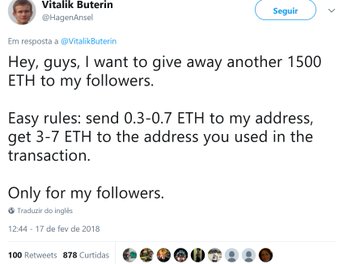
Cryptocurrency scammers are currently using Twitter to take advantage of naïve investors looking to make some easy money. Often, the scammers pose as influential community members and promote those that send them a specific cryptocurrency a reward a number of times greater than the initial donation. Now, they even started hijacking verified accounts to look more credible.
To legitimize the move, these scammers then add fake replies to the tweet asking for donations. These replies usually claim they’ve received the funds and thank the person. These scammers are usually easy to spot, as they use recently created accounts, with usernames with extra letters, and without a blue checkmark, only Twitter can give its users.
The amount of people falling for these scams is insane. The address the scammer is using currently has $20,000 worth of $ETH in it. #Twitter should do something, and please always look for the little blue badge #Ethereum@VitalikButerin
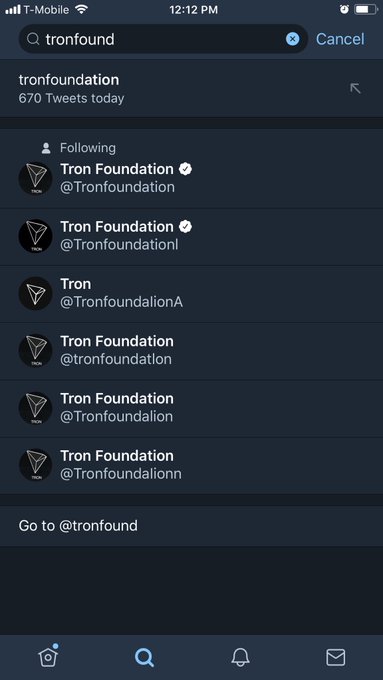
According to Buzzfeed News, scammers recently managed to create a fake, verified Twitter account for Tron Foundation, the organization behind TRON (TRX). To do this, they seemingly hijacked the account of Literacy Bridge, a nonprofit based in Seattle that’s focused on “improving the health, income & quality of life for the world’s most underserved communities.”
After taking over Literacy Bridge’s verified account, the scammers changed its profile picture, pinned a tweet just like the one the real Tron Foundation has pinned and changed the handle to “nonfoundational” – notice the extra “l”.
Using the fake account, the scammers then replied to a tweet posted by Justin Sun, Tron’s founder, asking for donations. The tweet, according to Buzzfeed, received over 200 likes and retweets, presumably thanks to the blue checkmark.
Some Twitter users noticed the change and quickly spread the word.
Geoff Goldberg, a Twitter user who frequently calls out spam accounts, spotted the fake Tron Foundation. Speaking to Buzzfeed News, he stated:
“I saw it was a verified account so immediately was intrigued. To me, it was clear it was a scam, given that I have been encountering these for quite some time. But to others, given the verified account, I could totally see people falling for it.”
After BuzzFeed and the Tron Foundation reported the fake account, it got taken down. This, however, wasn’t an isolated incident. Hackers seemingly managed to hijack another verified Twitter account belonging to a luxury menswear design team in London, going by “adaxnik.” After hijacking his account, the hackers then spoofed Justin Sun’s account.
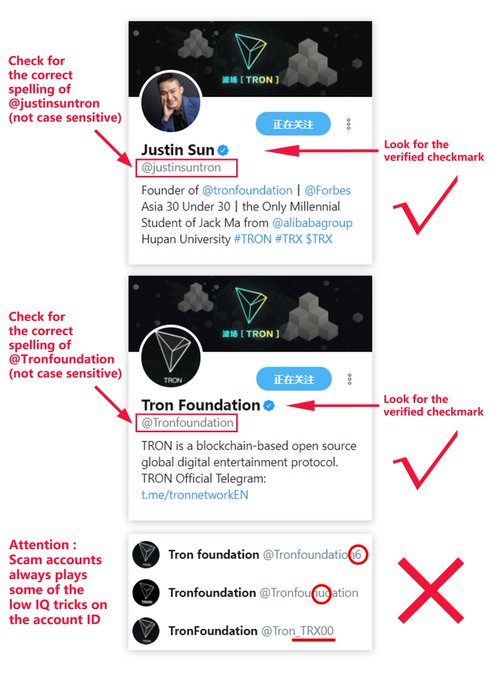
Some individuals and groups have counterfeited TRON official account and published untrue information lately. Please identify our official accounts carefully based on the following picture, thank you for your cooperation and strong support. @Tronfoundation@justinsuntron
At press time, Tron’s founder seemingly has two verified accounts on Twitter. One of them is trying to help users stay safe and expand Tron’s reach. The other one claims there’s a Tron airdrop on the way, and is sending users a link to a fake website I wouldn’t dare click on.
DON'T TRUST ANYONE ASKING FOR OR OFFERING MONEY ON TWITTER. DON'T TRUST ANYONE ASKING FOR OR OFFERING MONEY ON TWITTER. DON'T TRUST ANYONE ASKING FOR OR OFFERING MONEY ON TWITTER.
If you were awake during your Intro to Micro class, you might remember the topic of market failures. Generally, markets lead to efficiency. Market failures are situations where the market does not provide for an efficient result. People making decisions in their own self-interest, under these circumstances, make things worse for the masses. The fight over what is a market failure and the government’s response is the crux of economic and political debate.
Generally, proponents of big government identify, label and argue for more government intervention to fix these failures. Education, healthcare, inequality, and housing are areas where the debate over market failure are intense. Libertarians and other small government proponents feel government intervention just makes the problem worse. Consequently, they label these situations government failures. Governmental failures create massive misallocation, more central planning and other inefficiencies that create a huge market for lobbyists and rent-seekers. The historical track record of central planners making economic decisions in the aggregate is very poor.
Market Failures
Even Libertarians and other small government proponents would admit that markets do fail and a little government intervention is necessary to remedy true market failures. Economists have identified a few common market failures. They include monopolies, externalities, asymmetric information and public goods. These failures justify some type of intervention.
Monopolies – A monopolist is a producer who is the sole supplier of a good without a close substitute. Monopolists have the ability to raise the market price above equilibrium price where there is competition. Consequently, they can reduce output of a good and increase scarcity. Monopolists must be protected by some sort of barrier to entry.
Asymmetric Information – This situation occurs when one side of a transaction has more information than the other. Usually, this involves the seller having more information than the buyer. What really is in that medicine? How much revenue does that business actually produce? What is in that food? Food labeling laws, restaurant inspections, FDA approval, and the SEC are examples where the government has created laws to head off this sort of market failure.
Negative Externalities – Negative externalities are situations that arise from an economic activity that effects unrelated parties. Pollution is a classic example of a negative externality. Consumers and producers, acting in their own self-interest, create pollution which is harmful and destructive to everyone.
Non-Excludable Public Goods – The free market does a horrible job providing public goods that are non-excludable and nonrival. Non-excludable means that one cannot be excluded from using the good or service. Because one cannot be excluded from enjoying the benefits of the good, many people choose not to pay and become free riders. With so many free riders, beneficial public goods won’t be created. National defense, dams, and lighthouses are examples of public goods. The free market alone has a hard time raising money for these projects. Government is needed to raise the money for their construction and, in theory, everyone is better off once they are built.
Blockchain on Monopoly and Asymmetric Information
This is a simple brainstorm of how blockchain could help cure traditional market failures. This could help lead to more freedom, more efficiency, less scarcity and a more productive allocation of resources. Entire academic papers could be written on each of these topics. Once again, blockchain is a decentralized, tamper-proof ledger.
Monopoly – Generally, monopolies are created through regulation. Natural monopolies are very rare and some economists say they don’t exist. Essentially, monopolies need a moat, or a barrier to entry to protect them from competition. Cable companies, telecommunications, railroads and taxi cartels are examples of government-created monopolies. Because blockchain can circumvent regulation, government created monopolies will feel pressure with this new technology. Think Uber-like destruction in all government-created monopolies.
Asymmetric Information – When the seller of a product has more information that the buyer, they can take advantage of the buyer. Blockchain can verify. Blockchain can prove. Where and when did this meat originate? How much does this medical procedure cost? Why does it cost so much? What are the true revenues of this company and what is the history of this used car? What is in this drug and what are the verifiable results of people who have taken it? Blockchain can clearly help even the score between buyers and sellers. Markets could become more efficient. Less licensing will be needed and barriers to entry will be reduced. More people of all socioeconomic classes could start businesses easier. Prices can become more transparent. Life-saving drugs will be approved faster. Insurance pools will be more transparent and providers could be held more accountable.
Blockchain on Externalities and Public Goods
Negative Externalities – Many economists feel negative externalities result from situations where there is no market. They also usually occur where property rights are very weak. The air and ocean are good examples. It’s easy to dump pollutants into the air when property rights are so weak. Blockchain will help create markets in places with weak property rights. Think Cap and Trade. What is the optimal level of pollution in the air? Environmentalists could buy clean air credits and polluters would finally have to pay a price for creating negative externalities on common resources. Remember the tragedy of the commons? Imagine each cow and the pasture being recorded and priced with blockchain contracts.
Non-Excludable Public Goods – Groupon meets the Hoover Dam. Bureaucratic allocation of public goods and bridges to nowhere will decrease. Blockchain contracts will create public projects with more consumer choice. The more people join together on public goods, the cheaper the per person contribution will be. Unnecessary, bloated, corrupt projects will not happen. There could be lots of radical breakthroughs here leading to more efficiency with an increase in consumer and producer surplus.
Conclusions
Markets generally supply goods and services the most efficient way possible. Blockchain will slowly shine a light on the inefficiency of many government solutions to market failures. Economists and public policy analysts have barely scratched the surface of how blockchain can offer solutions to traditional market failures. Blockchain has the potential to increase choice. Consumers will make decisions based on their preferences. This will push out our production possibility curve, allowing us to do more with less, lessening the burden of scarcity and fight against rent-seeking. Additionally, it can reduce central planning and the misallocation of resources that accompany it. The traditional way of corrupt, inefficient, and expensive government solutions to these failures now will have competition. In free societies, logic, efficiency, and productivity usually win. I’m betting on blockchain.
Chicago, IL – CCN correspondent Eric Eissler had a chance to sit down with Chief Operating Officer Benjamin Weiss of CoinFlip at its Chicago headquarters to learn about the company, the ATMs, and the general outlook on cryptocurrency.
Cryptocurrency ATMs: A Brief History
CoinFlip makes ATMs to buy and sell Bitcoin, Litecoin, and Ethereum.
In the United States, there are 1,545 cryptocurrency ATMs according to CoinATMRadar. The first Bitcoin ATM manufactured by RoboCoin appeared in Vancouver, Canada in 2013 and since then the industry is growing at a rapid rate with many companies producing ATMs, however, the majority of ATMs only buy and sell Bitcoins. North America has 76% of all the world’s crypto ATMs, followed by Europe with 19.5% and Asia with only 2.10% of crypto ATMs which is rather surprising given all the crypto activity in Japan and South Korea. For more information and statistics on crypto, ATMs check out more from CoinATMRadar.
CoinFlip
Coinflip was founded in December of 2015. The company operates cryptocurrency ATMs that allow buying and selling of Bitcoin, Litecoin, and Ethererum all in one terminal. The rate charged at all CoinFlip’s ATMs is 6.9% above GDAX (Coinbase) spot price for buys, and 3.5% below for sells. The industry average buy rate is 8.86% based on 1,402 operational crypto ATMs. Buy and sell percentages are higher than using an online exchange, but the advantage is it is instant and in cash. For many online exchanges, there is a long lag period (usually days until the funds are in place) when buying with an ACH transfer from a bank.
CCN: What is Coinflip’s main goal?
Benjamin Weiss: We try to bring a physical aspect to something that is very abstract to people and that is why the ATMs have been such a big success so far. We have machines in over seven states currently with future national expansion and plan to be in many more places in a short time.
CCN: When did you form CoinFlip?
BW: December 2015 is when the company started and I would say it has really taken off since 2016.
CCN: Who is your primary user demographic?
BW: The demographics which are using the ATMs are crazy! It runs the gambit: from people who don’t have bank accounts and are using Bitcoin as their primary bank account, to people who are sending remittances to Mexico and other countries—because it is cheaper than traditional wire transfer services—to people high net-worth individuals who don’t want to buy Bitcoin from their computers and would rather just get it easily with cash by going to an ATM. Therefore, the spectrum is full, from one end to the other of the different demographics that are using the ATMs. There is no “average” user, it’s all over the map.
Benjamin Weiss of CoinFlip
CCN: Besides buying Bitcoin, you can also make withdrawals? Essentially selling Bitcoin and taking the cash.
BW: Yes, on certain ATMs there is the sell option. However, it is so early in the game that most of the transactions we have are buys and not sells. But the number of people cashing out now is getting higher because crypto prices have increased. I think as the market matures and as the market develops, you are going to see an even ratio of buying and selling.
CCN: Your ATMs are unique because they are, from what I have seen, the first ones to offer withdrawals. Can you elaborate on this feature?
BW: At the time, it is really rare to see the selling feature on Bitcoin ATMs, but as the price keeps going up, our strategy going forward is to keep working on the withdrawals capabilities to make sure people have that option to cash out.
CCN: Can you elaborate on the sell feature? How are you able to do it?
BW: It’s a more expensive operational model. We add features such as cash recyclers, in order to prevent having to go and restock the ATMs with cash. Sure, it’s a bit hard from an execution perspective but it’s something that can be done. We are continuing to develop this feature.
CCN: Have you had a problem where someone is trying to take out a very large sum of cash?
BW: Due to compliance and regulations with federal laws, we have a $7,500 cap on withdrawals. We handle hundreds of thousands of dollars in online and wire transfers, but most people would not be comfortable with taking out that much cash. And of course, we have taken these and other measures to protect against money laundering. To go above and beyond the minimum regulations, we have added more security such as with transactions over $3,000, which require a social security number (SSN), source of funds, purpose of funds, and we run software that can validate the SSNs so fake ones cannot be accepted. However, we would never let users type in their SSNs into an ATM, this is done one time, over the phone with our customer support team.
CCN: So, you need to have an account to use the ATM?
BW: No, if the amount is more than $700 then you need to swipe your ID and we run a check to ensure you are not a sanctioned individual and you are allowed to use the financial institutions of the United States. You only need to register and this step is to prevent money laundering.
CCN: Which currencies can you buy at your ATMs?
BW: Bitcoin, Litecoin, and Ethereum. We are working on adding other coins, but I can’t say which.
CCN: What is your outlook on Cryptocurrency?
BW: Very positive. That’s why we have created these ATMs to make it easy for the average person to buy it. For the average person, it can be a challenge to buy cryptocurrency. There is this amazing financial technological revolution going on and we want to ensure everyone can take part; we want an ATM on every corner. We are motivated by bringing cryptocurrency to everyone.
Also, the use of crypto varies country to country. For example, in the U.S. Bitcoin is more of an asset or store of value, but in Venezuela, where the currency has been totally debased, Bitcoin is a life-saving payment system. Remittances are big for us, because it’s cheaper, faster, and more efficient. With the implementation of the Lightning network the fees have come down, around $2.00 now and the transactions are much faster than they were a few months ago.
CCN: Bitcoin Cash was poised to take over based on speed and costs a few months ago, but now after SegWit and Lightning, what are your thoughts on Bitcoin’s longevity?
BW: It’s here to stay. Period. I could see Bitcoin at $100,000. I mean it’s so early in the game. I am a huge believer in it long term. It’s hard to have a serious investment portfolio that doesn’t include Bitcoin.
CCN: What are your thoughts on the Illinois Blockchain Initiative? The state agencies want to create a better, more secure system of record keeping.
BW: I think the Government, regardless of what they think of cryptocurrencies, they know that blockchain is amazing and they want to benefit from it. I think they should because look at the hit Equifax took with that data breach. If you had this information on a blockchain it would be way more secure. So, I think what you are going to see in the near term is the Illinois government and all other governments are going adopt this technology. You will see medical records, property deeds, ownership records, and all sorts of sensitive data is going to end up on blockchain. Once the Government and states do this, we hope that they will come to recognize that cryptocurrencies are another amazing facet of blockchain. There is room for companies like us, citizens, and government to all work together to reap the benefits of this technology.







Social Media Icons 2